
You’re missing a tooth. Maybe it’s been gone for years. Maybe it just happened. Either way, you’ve got a decision to make, and you’ve probably heard two main options tossed around: dental implants or a bridge. Most dentists will tell you both work. And they’re not wrong. But at Dr. Dall’olmo’s practice, we ask a different question: Which one actually respects your natural teeth more?
Once you lose a tooth, the goal shouldn’t just be filling the space. It should be protecting everything that’s still healthy. And that’s where implants and bridges go in completely different directions.
How a Traditional Bridge Works
A traditional bridge doesn’t stand on its own. It needs anchors. To place a bridge, your dentist has to shave down the two teeth on either side of the gap, teeth that are likely perfectly healthy. Those shaved teeth then get crowned, and the false tooth (or teeth) hangs between them.
Think about that for a second. You lost one tooth. To fix it, you’re now altering two healthy teeth. Teeth that never asked to be involved.
Worse, those crowned teeth are harder to clean around. Plaque builds up underneath the bridge over time. And eventually, those anchor teeth can develop decay or gum disease. What started as one missing tooth can turn into three problem teeth down the road. That’s the opposite of preservation.
How a Dental Implant Works
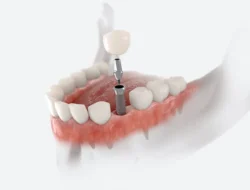
An implant, on the other hand, leaves your neighbors alone. Dr. Dall’olmo places a small titanium post directly into your jawbone where the tooth’s missing. Over a few months, that post fuses with the bone, just like a natural tooth root. Then we attach a custom crown on top.
That’s it. No shaving. No crowding. And no involving innocent teeth. The teeth on either side stay exactly as they were. Full enamel. No drilling or future decay risk from a poorly fitting bridge.
Why This Fits Bio-Emulative Dentistry
Bio-Emulative dentistry is built on one simple belief: preserve the maximum amount of healthy tooth structure possible.
A bridge violates that belief. It sacrifices two good teeth to replace one bad one. That’s not preservation. That’s trading.
An implant honors the principle. It stands alone. It doesn’t ask healthy teeth to pay the price for a missing one. And because Dr. Dall’olmo performs the entire procedure under one roof, from surgery to final crown, you get continuity of care that most offices can’t offer.
What About Cost and Time?
A bridge is usually cheaper upfront and faster to complete. Two weeks, maybe three. An implant takes several months and costs more initially.
But here’s what the quick fix doesn’t tell you. A bridge will likely need replacement every 10 to 15 years. Each time you replace it, those anchor teeth get shaved down a little more. There’s only so much tooth left to shave.
An implant, properly cared for, can last a lifetime. You pay more once. You’re done.
Restore Your Smile Today
If you want to fill a gap today with the least money and time, a bridge technically works. But if you want to protect your remaining natural teeth for the rest of your life, if you believe healthy teeth shouldn’t be sacrificed to fix a missing one, then an implant’s the clear choice.
At Dr. Dall’olmo’s office, we recommend preservation every time. Come see us, and we’ll show you the difference.